Free electron beams as nano-source of multipolar light
December 1, 2025
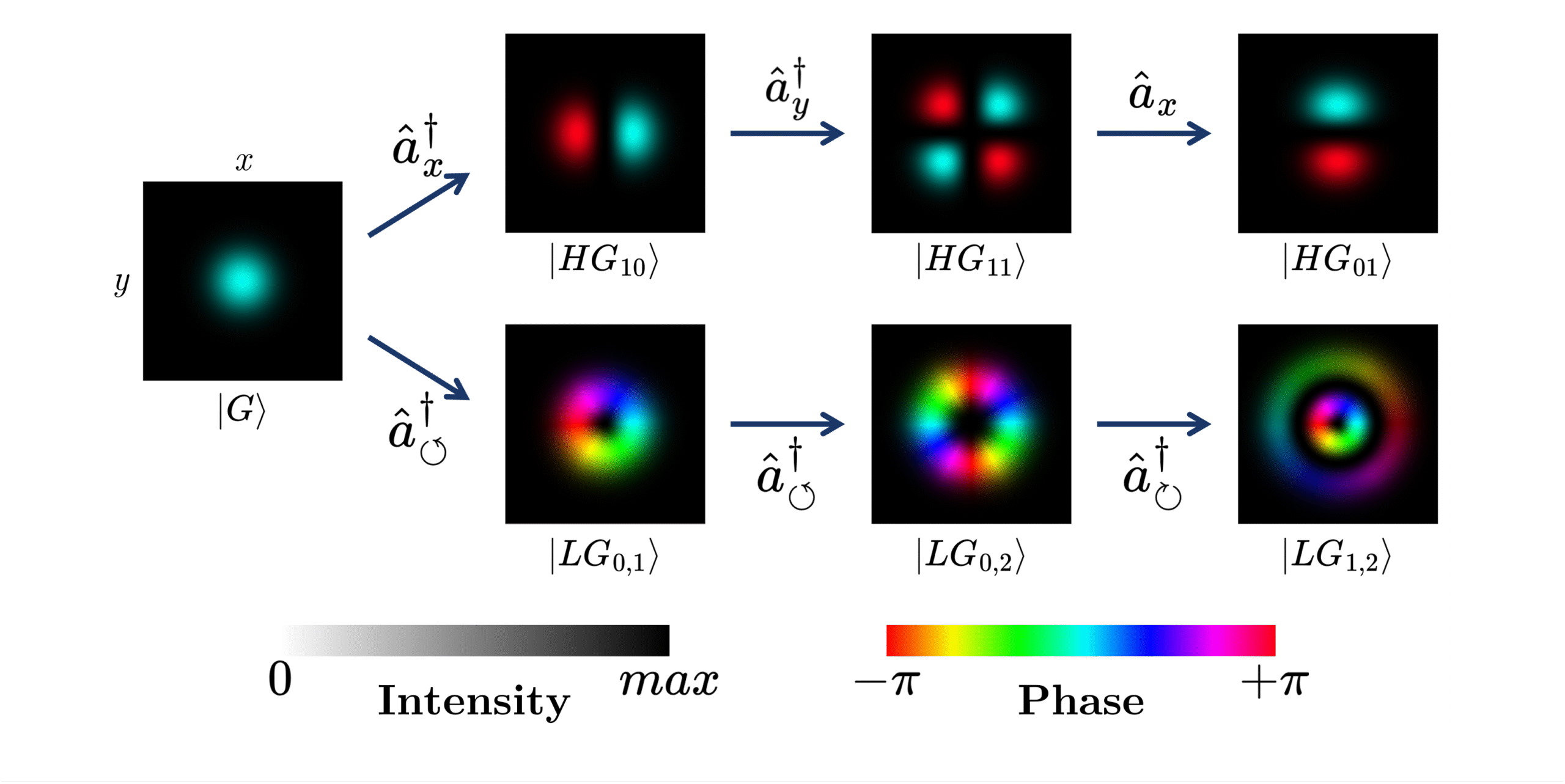
In this work, we have developed a quantum ladder-operator formalism describing the inelastic scattering of a structured free electron beams by a target (e.g. nano-structured material, molecules). It enabled us to transpose several macroscopic optical concepts—such as dichroism—down to the deep subwavelength scale.
Pushing optical spectroscopy down to the deep subwavelength scale is a central issue for material science and a one of the main axes of research in nano-optics for the last decades.
This technical endeavor has – in particular – been tackled by the field of electron microscopy. Indeed, it has been shown that focusing an electron beam on a sample and looking at the energy lost by the electron provides the same information as optical extinction spectroscopy (A. Losquin et al, Nano Lett. 15, 2015), however with a much better spatial resolution (sub-Angstrom).
Yet, this technique called electron energy-loss spectroscopy (EELS) suffered from an essential drawback compared to optical spectroscopy: the absence of a polarization degree of freedom.
How does one generate an analogue of polarization in an electron beam? Over the past ten years, this subject has been the focus of intense investigation. Following a series of seminal works (see e.g. A. Asenjo-Garcia & F. J. García de Abajo, Phys. Rev. Lett. 113, 2014), a proposition came in 2021 (Lourenço-Martins et al., Nat. Phys. 17, 2021): one can encode a polarization in an electron beam by shaping and post-selecting the amplitude and the phase of its wavefront.
This scheme – called Phase-Shaped EELS (PSEELS) – is now an established and hotly investigated technique to perform polarized optical spectroscopy down to the atomic range and explore important question such as the nature of optical chirality at the most fundamental scale. The story seems to be told: electron and photons probe the same physics.
This is where our work comes into play: we demonstrate that by considering more complex wavefronts, PSEELS can go further than mimicking the polarization and access an infinite family of degrees of freedom unreachable with far-field optical techniques. Loosely speaking, we provide the conditions in which the electron beam of a TEM would behave as a nano-source of light carrying a pure quadrupolar, octupolar, … momentum.
Contacts:
Hugo Lourenço-Martins | hugo.lourenco-martins[at]cemes.fr
Simon Garrigou | simon.garrigou[at]gmail.com
Publication:
Atomiclike Selection Rules in Free Electron Scattering
S. Garrigou & H. Lourenço-Martins
Physical Review Letters 134, 256902 (2025)
DOI: https://doi.org/10.1103/l2y2-99jx