How to quantitatively map spin dynamics in TEM
November 24, 2025
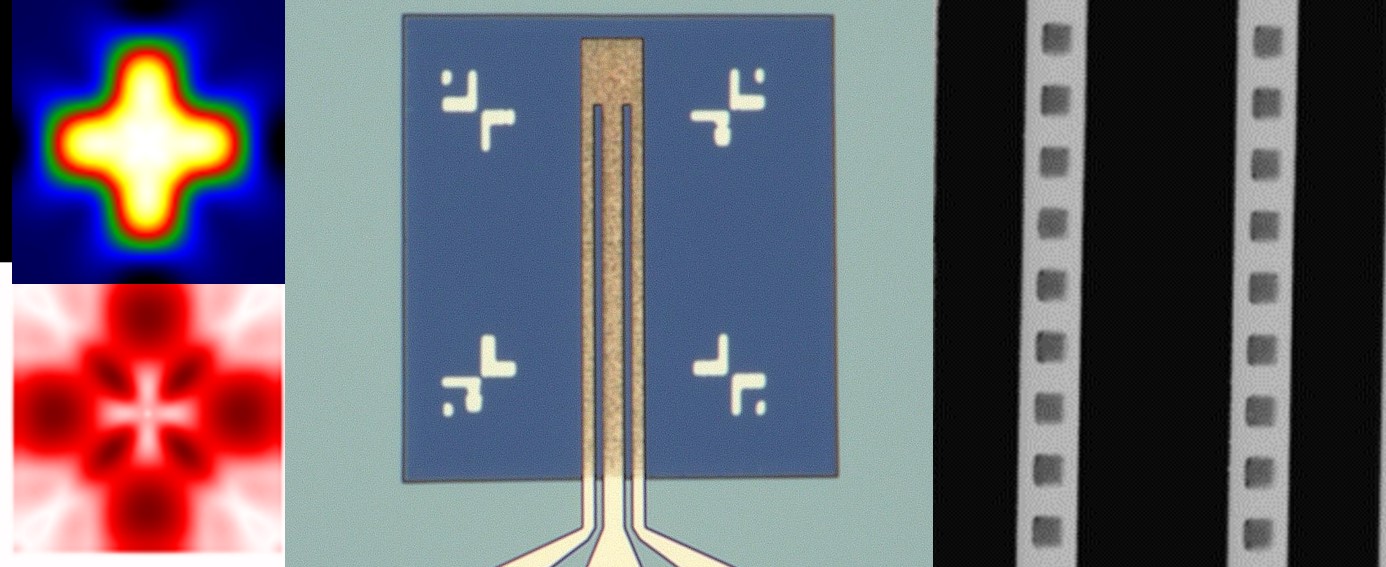
We propose a method based on electron-holography to image spin waves in nano-objects with nanometer resolution. Our simulations and hologram reconstructions demonstrate that local magnetization precession at the Gigahertz can be locally mapped, thus enabling the correlation with structural and chemical information and providing a more comprehensive understanding of spin dynamics at the nanoscale.
The rapid development of magnonics, the field focused on manipulating of spin waves to design low energy consuming devices, requires new approaches to probe spin dynamics at the nanoscale, especially in complex remanent magnetic states. Only a few techniques provide the spatial resolution required to access phenomena occurring over a few nanometers.
Optical methods are diffraction-limited (~300 nm). µ-BLS improves this to a few tens of nanometers, reaching ~10 nm with Mie resonators. Near-field microscopies, such as NV-center microscopy, offer similar resolutions but rely on external magnetic fields, making them unsuitable for remanent-state studies. X-ray based methods can achieves ~10 nm resolution but depends on chemical sensitivity and synchrotron access.
Transmission electron microscopy (TEM) provides a highly versatile platform for mapping electromagnetic fields with nanometer precision. Among the TEM methods, off-axis electron holography can quantitatively map magnetic induction at nanometric. Here we show how its high phase sensitivity can be used to detect the subtle, time-averaged magnetic variations generated by magnetization precession associated with spin waves in the GHz range. These variations are retrieved by subtracting the equilibrium magnetic phase image from that of a precessing state obtained through micromagnetic simulations.
Using a Permalloy square as a model system, our simulations reveal that the main spin-wave modes generate a weak yet detectable magnetic signal, provided the microwave excitation amplitude is properly tuned and the experiment benefits from optimized TEM conditions (direct electron detection, improved stability, refined acquisition schemes). Reconstructed holograms reproduce the spatial symmetry of the simulated modes, allowing quantitative mapping of the local precession amplitude.
We also propose a feasible TEM configuration using a microstrip-based excitation system and outline the remaining challenges related to integrating high-frequency signals inside the TEM column. Overall, this work establishes both the conceptual basis and practical requirements for imaging spin-wave modes in nanostructures using electron holography, offering a powerful route to unravel nanoscale spin dynamics essential for future GHz magnonic technologies.

(a) Principle of off-axis electron holography. (b) Scheme of the time-averaged magnetic dynamic component 〈M ⃗_dyn 〉 compared to static magnetization M ⃗_stat when the dynamic magnetization M ⃗_dyn oscillates under a microwave field. (c) Example of the dynamic MZ (t) component calculated for a spin dynamic mode. Corresponding holograms for some MZ values are shown below. The position of the square magnetic dot is marked by the yellow contour.
This work has been published in Applied Physics Letters and featured by the editor.
Contacts:
Christophe Gatel | christophe.gatel[at]cemes.fr
Nicolas Biziere | nicolas.biziere[at]cemes.fr
Publication:
Concept of imaging spin waves in pseudo-static mode by electron holography
M. Resano, C. Gatel, A.C. Torres-Dias, B. Lassagne, and N. Biziere
Applied Physics Letters 127, 212404 (2025)
DOI : https://doi.org/10.1063/5.0294261
-
Previous Post
PhD defense of Agathe Duclos
Related Posts

Camille Thenot
BIATSS UT (IGE)