When four friends fall under the spell of the forms that light and matter can take
January 23, 2026
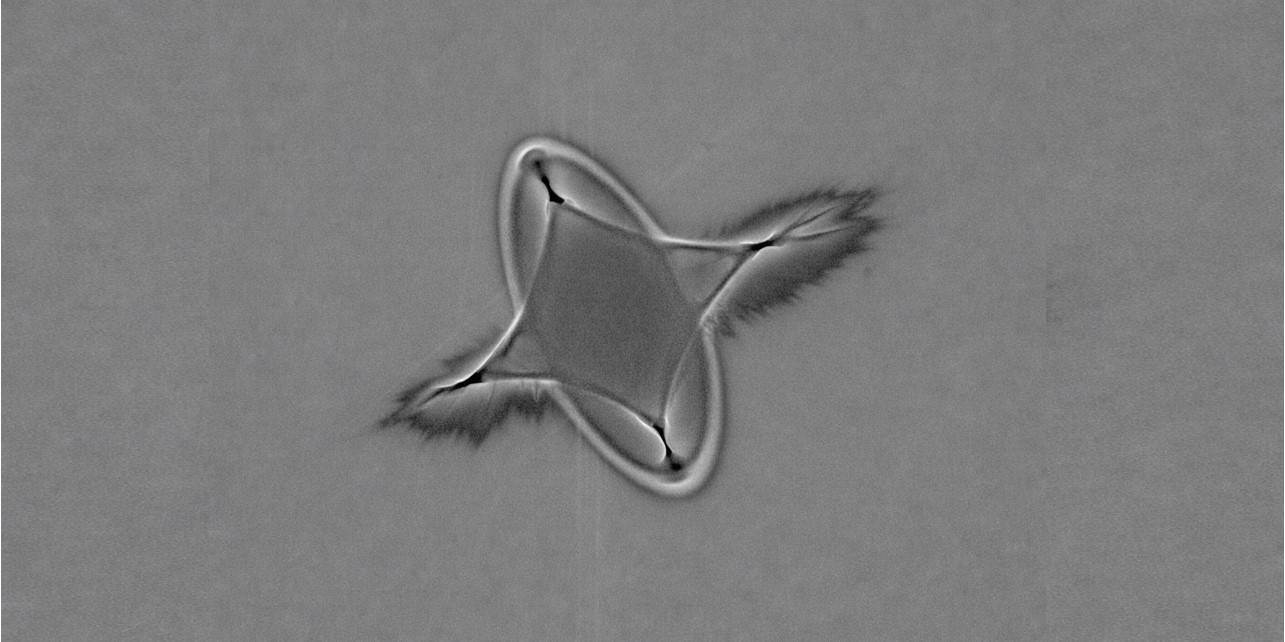
By adapting to charged particles the catastrophe theory developed by mathematician René Thom, this work explores the topologies of caustics observed in instruments that use electrons or ions, such as electron and ion microscopes.
Here is a study initiated by four friends working at CEMES whose curiosity was accidentally piqued by the contemplation of bright luminous shapes called caustics. If you pay attention, these shapes can be observed every day at home thanks to the presence of light around us. As shown in Figure 1.A, all you have to do is observe, for example, the concentration of light in these intense areas with their characteristic points on the edge of a table positioned behind the base of a glass.
Identical forms can also be observed when an electron beam is focused on a screen by a magnetic field or an ion beam on a surface by an electric potential (Figures B and C respectively). Of course, behind these figures lie the laws of geometric optics, so a priori nothing could be more mundane. But what ultimately transforms this contemplation into scientific obsession is the observation that these shapes are also present in natural phenomena whose laws are, at first glance, very different from those of optics. The cusp, that typical bright point observed in the three situations in Figure 1, is found, for instance, developing around the stem during the growth of an apple [1]. Many other examples have been discovered and reported in the literature [2].
In all these situations, these figures are characteristic of a sudden and violent change in the state of the system under study. The French mathematician René Thom was the first to understand the origin of the universal nature of these complex forms [3]. In fact, all natural phenomena necessarily follow a principle of least action characterized by the equilibrium surface of a function known as a ‘characteristic’. A bifurcation of a system will be observed if this equilibrium surface allows several stable solutions at the same time, illustrating the fact that the system must make a ‘choice’ between several possible equivalent states. For René Thom, the origin of the form common to all these materials can thus be approached with a high degree of mathematical abstraction by ‘simply’ studying the topology of this equilibrium surface. The physical study of a system then amounts to identifying these bifurcation zones, called catastrophes, in the equilibrium surface [4].
The study carried out at CEMES is an application to the case of charged particle optics with the aim of explaining the nature of the figures also observed with electron and ion beams (Figures 1.B and C). Research that began without any real quantitative objective, guided only by intuition and the desire to shed light on a common, almost mundane phenomenon, seems to be leading to unexpected applications. It is because intuition seems obscure that it is illuminating, something we must remind ourselves every day as researchers!
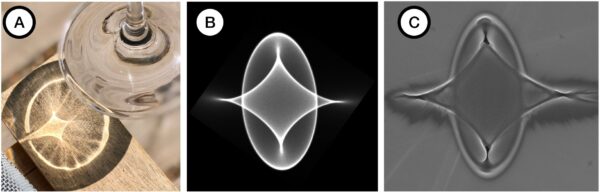 Figure 1: Caustics observed on a screen with: a- a beam of light b- a beam of electrons c- a beam of ions
[1] Chakrabarti, A., Michaels, T.C.T., Yin, S. et al. The cusp of an apple. Nat. Phys. 17, 1125–1129 (2021). https://doi.org/10.1038/s41567-021-01335-8
[2] Poston, T., Stewart, I., 1996. Catastrophe Theory and Its Applications. Courier Corporation.
[3] Thom, R., 1974. Stabilité structurelle et morphogenèse. Poetics 3, 7–19. https://doi.org/10.1016/0304-422X(74)90010-2
[4] Berry, M.V., Upstill, C., 1980. IV Catastrophe Optics: Morphologies of Caustics and Their Diffraction Patterns, in: Wolf, E. (Ed.), Progress in Optics. Elsevier, pp. 257–346. https://doi.org/10.1016/S0079-6638(08)70215-4
Contacts:
Tom Fraysse | tom.fraysse[at]cemes.fr
Robin Cours | robin.cours[at]cemes.fr
Hugo Lourenço-Martins | hugo.lourenco-martins[at]cemes.fr
Florent Houdellier | florent.houdellier[at]cemes.fr
Publication:
Morphologies of caustics studied by catastrophe charged-particle optics
T. Fraysse, R. Cours, H. Lourenço-Martins, and F. Houdellier
Ultramicroscopy 282 (2026) 114291
DOI : https://doi.org/10.1016/j.ultramic.2025.114291
Related Posts
The Fierce Morphological Battle of Silver Nanoparticles
September 2, 2026
Glaciers: Sentins of Climate Change
Thursday, June 18, 2026 Seminar by Etienne Berthier, LEGOS, Observatoire Midi-Pyrénées Open to all