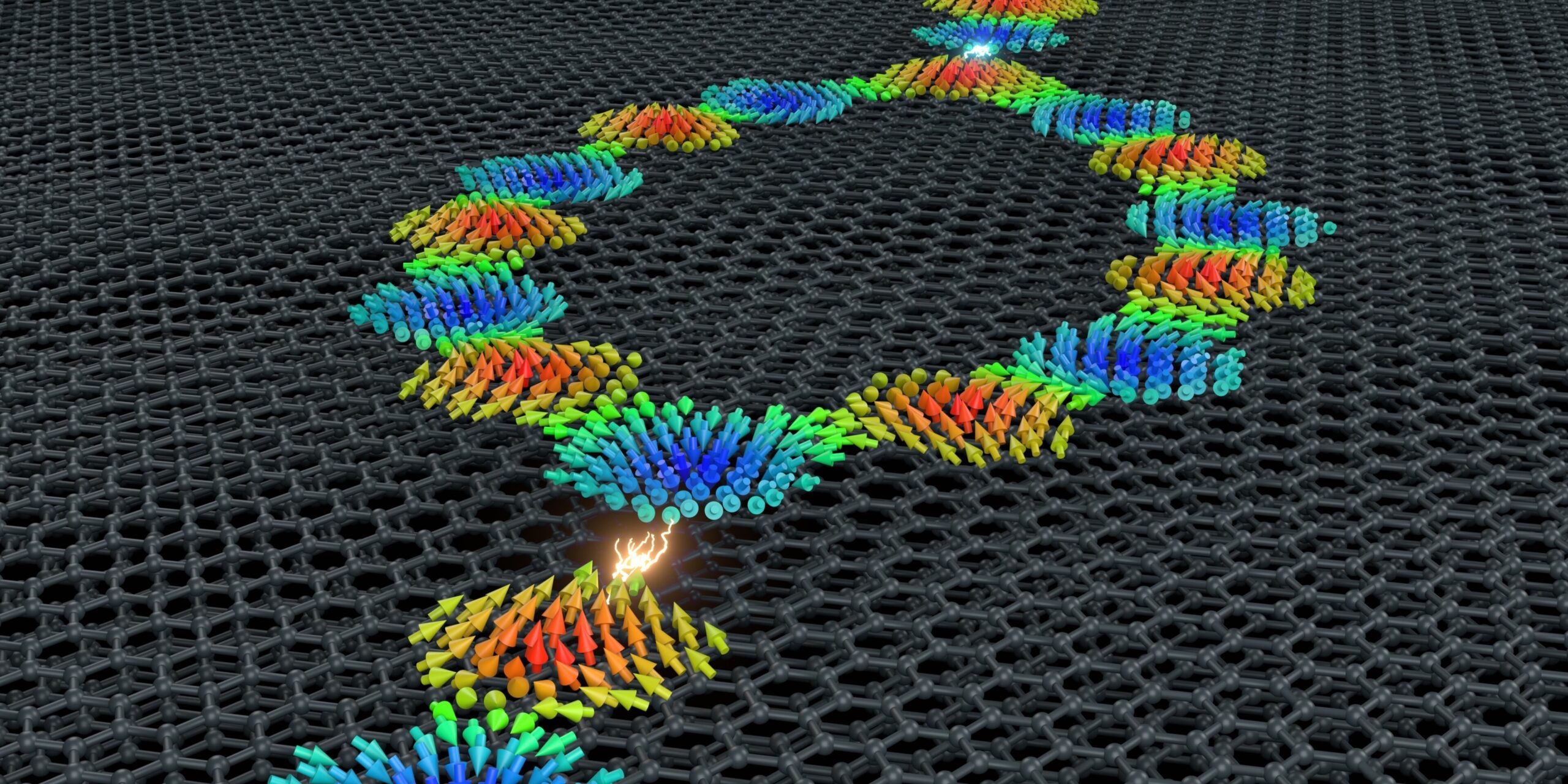
Reduced symmetry, nonlocal behavior, and enhanced thermal stability in 2D magnets
October 27, 2026
Researchers from the MEM group at CEMES-CNRS, in collaboration with Kiel University (Germany), demonstrate that magnetic bimerons are fundamentally different from skyrmions. Their reduced symmetry, accompanied by long-range inter-soliton interactions and particle-antiparticle degeneration, promotes the ability to form stable network-like macrostructures, opening new perspectives for future information storage and computing technologies.
Magnetic skyrmions, vortex-like spin textures with a topological charge Q=-1, have attracted considerable interest for spintronic computing architectures that integrate memory and information processing, potentially overcoming the von Neumann bottleneck. In this context, a sufficient thermal stability of solitons is essential for non-volatile in-memory computations. However, in the literature, this essential aspect is rarely addressed, due to the computational and analytical complexity of the task. In particular, no lifetime estimation of bimerons, generally regarded as a particular type of skyrmion, has been reported for any material until now.
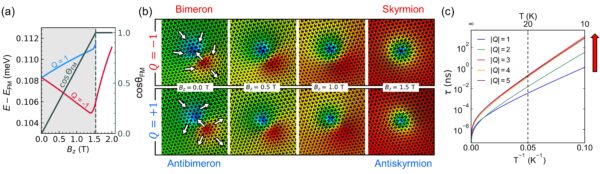 (a) Magnetic-field dependence of the energies for bimerons (Q=-1, red) and antibimerons (Q=+1, blue). (b) Field-induced transformations of bimerons into skyrmions (top) and antibimerons into antiskyrmions (bottom). (c) Lifetimes of high-Q bimerons at Bz = 0 T shown over inverse temperature for different Q.
In three theoretical studies published in 2026 [1-3], the researchers reveal new mechanisms governing the emergence and lifetime of bimerons in 2D materials (see Fig. 1). Using ab initio theory and atomistic spin simulations, the researchers predict the coexistence of skyrmions and bimerons, as well as field-induced transformations between them, in an experimentally feasible van der Waals heterostructure, Fe3GeTe2/Cr2Ge2Te6 [1]. They further extend transition state theory to calculate, for the first time, the lifetimes of bimerons and antibimerons. Remarkably, they challenge the widespread belief that bimerons are simply the in-plane counterparts of skyrmions. They demonstrate that their reduced spatial symmetry in a rotationally invariant environment gives rise to fundamentally different properties compared to skyrmions, including spatial localization, entropy-dominated thermal stability, and instanton-like behavior under an applied magnetic field [2]. Building on these discoveries, the researchers extend their investigations to high topological charge (|Q| > 1) bimerons and antibimerons [3]. Surprisingly, they predict that the lifetimes of high-Q bimerons can be enhanced by up to three orders of magnitude compared to simple bimerons (|Q| = 1).
Together, this bimeron trilogy establishes theoretical foundations for understanding the emergence, stability, lifetime, and collective behavior of bimerons, paving the way for future investigations and spintronic applications, particularly reservoir and neuromorphic computing.
Contact:
Dongzhe Li | dongzhe.li[at]cemes.fr
Publications:
[1] Emergence of multiple topological spin textures in an all-magnetic van der Waals heterostructure
Moritz A. Goerzen, Tim Drevelow, Hendrik Schrautzer, Soumyajyoti Haldar, Stefan Heinze, and Dongzhe Li
Phys. Rev. B 113, 094420 (2026)
DOI: https://doi.org/10.1103/g149-5gyd
[2] Lifetime of bimerons and antibimerons in two-dimensional magnets
Moritz A. Goerzen, Tim Drevelow, Soumyajyoti Haldar, Hendrik Schrautzer, Stefan Heinze, and Dongzhe Li
Phys. Rev. B (2026), accepted
DOI: https://doi.org/10.1103/b2jq-63z9
[3] Strongly enhanced lifetime of higher-order bimerons and antibimerons
Shiwei Zhu, Moritz A. Goerzen, Changsheng Song, Stefan Heinze, and Dongzhe Li
Nano Letters 26, 6307–6314 (2026)
DOI: 10.1021/acs.nanolett.6c00092
-
Previous Post
PhD defense of Tom Fraysse
Related Posts
Bimeron Trilogy: Beyond magnetic skyrmions
October 27, 2026
Grain boundaries transform silicon into a plasmonic material
October 1, 2026