From a ton-scale industrial dye to a sustainable photocatalyst
November 23, 2026
Faced with the global water pollution crisis, the UN’s Sustainable Development Goal 6 calls for clean water and sanitation for all. To address this challenge, researchers from France, Poland, Canada and South Korea have developed an ecological, effective, and accessible photocatalyst for treating wastewater.
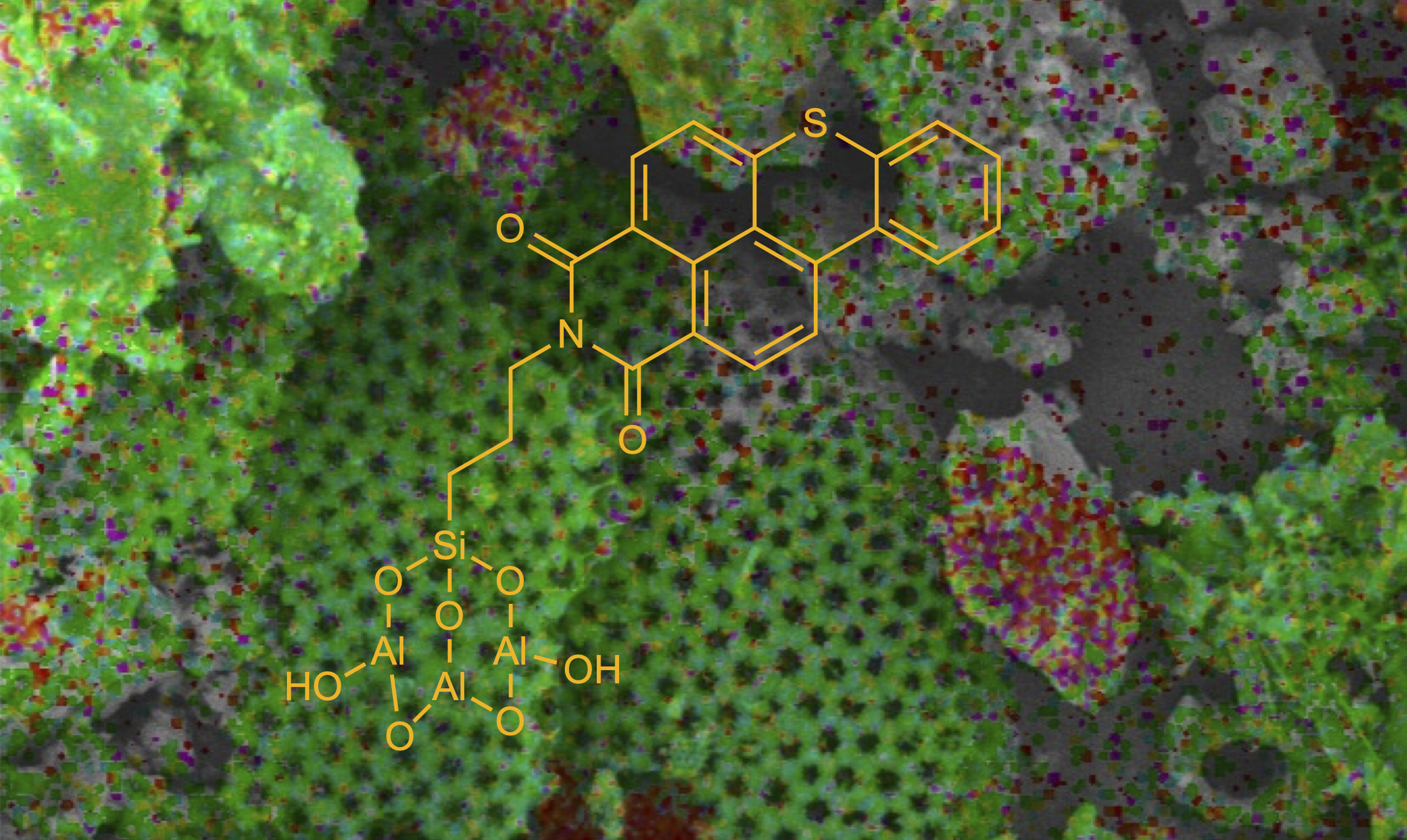
By using green chemistry principles, a common industrial dye (benzothioxanthene imide, or BTI) was sustainably attached to abundant mineral supports such as alumina and millimeter-sized molecular-sieve beads (Fig. 1a). Under low-intensity visible light, this hybrid material generates highly reactive molecules in water. As highlighted by the discoloration of the pollutant rhodamine B solution in Fig. 1b, these reactive molecules break down organic pollutants into harmless compounds such as CO₂ (Fig. 1c), without the need for additional metal co-catalysts or oxidants.
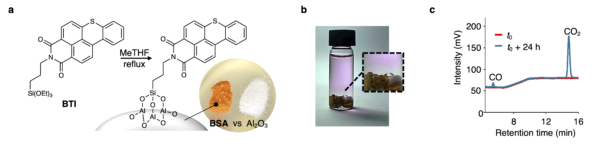
Figure 1. Turning visible light into clean water with a new hybrid photocatalyst material. (a) Preparation of the photocatalyst using green chemistry principles. (b) Photograph of a rhodamine B solution in water, showing the clearly visible discoloration of rhodamine B at the interface with the catalyst settled at the bottom, under ambient light. (c) Gas chromatography showing the decomposition of the pollutants into small molecules such as CO and CO2.
Tests showed the material can degrade a wide range of contaminants, including dyes from the fashion industry, pharmaceuticals, and agrochemicals; for example oxybenzone, a sunscreen ingredient known to disrupt coral reproduction. In many cases, a full decomposition of the pollutants to harmless compounds was observed. Yet the catalyst itself retained its activity through 12 months of continuous operation in water.
The technology also adapts easily to field conditions. As a fine powder, it offers a large contact surface, ideal for rapidly purifying tanks of stagnant water. As millimeter-sized beads, it is extremely easy to filter, recover, and reuse in systems where water flows continuously. Pilot-scale tests have confirmed the robustness and durability of these materials, which could be integrated into existing treatment infrastructure.
Economical, reusable, and simple to deploy, this technology offers an autonomous and modular alternative, particularly valuable for purifying water as close as possible to where it is needed, especially in resource-limited regions.
Contacts:
Dominik Lungerich | dominik.lungerich[at]cemes.fr
Clément Cabanetos | clement.cabanetos[at]univ-angers.fr
Publication:
Scalable Hybrid Photocatalysts for Visible-Light Degradation of Waterborne Organic Contaminants
N. Plassais, D. P. Sánchez, J. Park, K. Saczuk, P. Josse, A. Kassem, G. Park, A. Harshan, S. Cho, O. F. Jafter, A. H. G. David, B. Walker, L. Khrouz, C. Michel, T. L. Bahers, C. Monnereau, H. S. Ahn, M. Deiana, G. C. Welch, D. Lungerich, and C. Cabanetos
Advanced Materials (2026)
DOI: https://doi.org/10.1002/adma.75719
Related Posts
Turning visible light into a water-cleaning tool
November 23, 2026

Women in Computing: Cosmetic Measures and Effective Devices
Thursday, December 3, 2026 Seminar by Isabelle Collet, University of Geneva, Switzerland Open to all