A photoactive molecule to fight forgery and fraud
November 9, 2026
The modernization of counterfeiting activities represents a threat to society, making difficult to detect and eliminate fraudulent products. A group of researchers from France, Spain and Japan has designed novel photoactive molecules that can be solution-processed in thin-film and irradiated to engrave easily anti-counterfeiting signatures. Compatible with multiple patterning processes, this approach enables any kind of design, even your favourite masterpiece!
Forgery and falsification have become in the last decades a real danger to the global economy and public health. Moreover, the identification of fraudulent reproductions has become challenging due to the development of counterfeit technologies, making the use of anti-counterfeiting signatures a necessary and straightforward approach to confirm the origin of goods, whether they are drugs, food or cloths. In this sense, luminescent patterns with a double authentication level represent one of the most promising strategies owing to their unique optical properties that make fraudulent replication improbable.
In this study, a commercially available organic dye, namely perylene diimide, has served as a platform to design new luminescent functional material capable of undergoing photoinduced modifications (Figures a and b). These permitted switching the optical properties of the compounds under specific light irradiation while retaining high fluorescence efficiency, perfect breeding ground for double authentication level. Combined with the excellent processability of the materials by solution-processing techniques, the latter allowed the researchers to fabricate ultrathin films with engraved patterns that can be placed on any kind of product to lately verify that it is not a fraudulent good.
The process consists in designing a unique and personalized signature or figure and inscribe it on the molecular thin film via light irradiation, either using a predesigned mask or through laser micropatterning (Figure d). The thin film can be placed on boxes, certificates or directly on the product, such as cloths and electronic devices. The anticounterfeiting signatures can then be verified at will by optical microscopy and/or fluorescence microscopy, which reveal two strictly complementary patterns with distinct optical properties, forming upon overlay the encrypted symbol (Figure c).
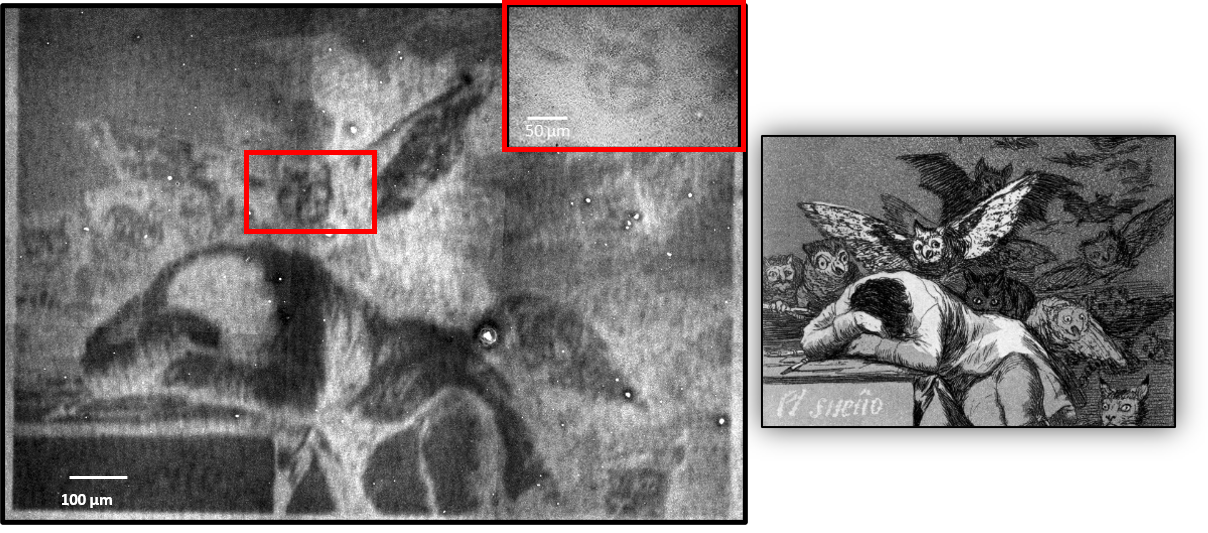
Eventually, using Alveole’s maskless photomicropatterning technology, the researchers could engrave on the material thin films extremely detailed micro-signatures, such as 100 µm-side QR codes and even figures as complex as artistic paintings. As an example, a tiny reproduction of Goya’s aquatint “The Sleep of Reason Produces Monsters” was photoprinted with dimensions 1.8 × 1.3 mm2 and observed under confocal microscopy with micrometric definition (top image).
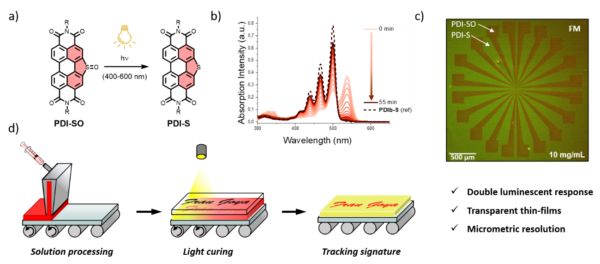
a) Visible-light-induced deoxygenation reaction of PDI-SO molecule and b) absorption spectroscopy profile along the monitored photodeoxygenation reaction giving PDI-S. c) Anti-counterfeiting symbol engraved on a PDI-SO thin film upon light-curing using a chromium-based template. Using diluted solutions (10 mg/mL), transparent thin-films for encryption applications were achieved and after photopatterning, an overlay of the complementary green and red patterns observed by fluorescence microscopy (λexc = 490 and 560 nm, respectively) revealed the encrypted symbol. d) Schematic representation of the PDI-SO photoprinting process using a mask on top of a solution deposited film.
This work demonstrates a new approach to anti-counterfeiting technologies with multilevel authentication by combining molecular engineering, materials processing, and advanced photoprinting methodologies. The project has been conducted through a collaborative effort between the BCMaterials in Bilbao, the University of Kyoto, the LAAS and the CEMES and the University of Toulouse.
Contacts:
Pablo Simon Marques | pablo.simon[at]bcmaterials.net
Claire Kammerer | claire.kammerer[at]cemes.fr
Nicolas Bréfuel | nicolas.brefuel[at]cemes.fr
Publication:
Unforgeable Red: Design and Application of SO-Annulated Perylene Diimides for Anti-Counterfeiting
P. Simón Marqués, S. Pérez-Domínguez, N. Bréfuel, J. M. Porro, S. Ueno, N. Saffon-Merceron, H. Yamada, L. Malaquin, and C. Kammerer
Small (2026), 22, e74331
DOI: https://doi.org/10.1002/smll.74331
-
Previous Post
Bimeron Trilogy: Beyond magnetic skyrmions
Related Posts
When expressionism becomes high definition
November 9, 2026
Bimeron Trilogy: Beyond magnetic skyrmions
October 27, 2026